

About the journal
Aims and Scope
The Journal for Sustainability and Technology in Vocational Education and Training Research (SUST-VET) is an international journal with a double-blind peer review. The journal publishes theoretical and empirical papers that focus on sustainability and/or technology in vocational education and training. The journal also publishes systematic literature reviews and meta-analyses.
Contributions should deal with formal or informal teaching and learning processes at all levels and in all institutions and organizations of vocational education and training which show a clear reference to sustainability and/or technology. Educational institutions are understood broadly and can range from vocational schools, businesses, chambers, universities and other institutions or organizations. Contributions dedicated to curricular, legal, methodological or intentional aspects of technology and sustainability are also welcome.
Open Access, Funding and Article Processing Charges (APCs)
As a platform for scientific discourse, papers are published via Diamond Open Access. This means that all contributions are made available to both authors and readers free of charge and can be accessed at any time. Thanks to public funding, contributions can be reviewed independently of economic constraints and made available freely to society while ensuring a high quality. All contributions are made available under the Creative Commons License - Attribution (CC-BY 4.0).
This journal is a pure open access journal. The journal does not charge neither article processing charges (APCs) nor article submission charges. For authors, neither the submission nor the publication of articles in the journal incurs any costs.
Sections
Three sections are offered to organize a continuous accumulation of knowledge:
- Taking stock: The “Taking stock” section aims to aggregate, describe and discuss the current state of research for a sub-area either through a comprehensive, systematic literature review or in the form of a meta-analysis of empirical studies. Submission to this section is possible at any time.
- Next steps: The “Next steps” section makes it possible to submit a theoretical contribution or an empirical study at any time and thus continuously expand the state of research.
- Focus: The “Focus” section aims at a specific topic of the subject area or a specific problem. The content and submission deadlines are communicated via calls for papers.
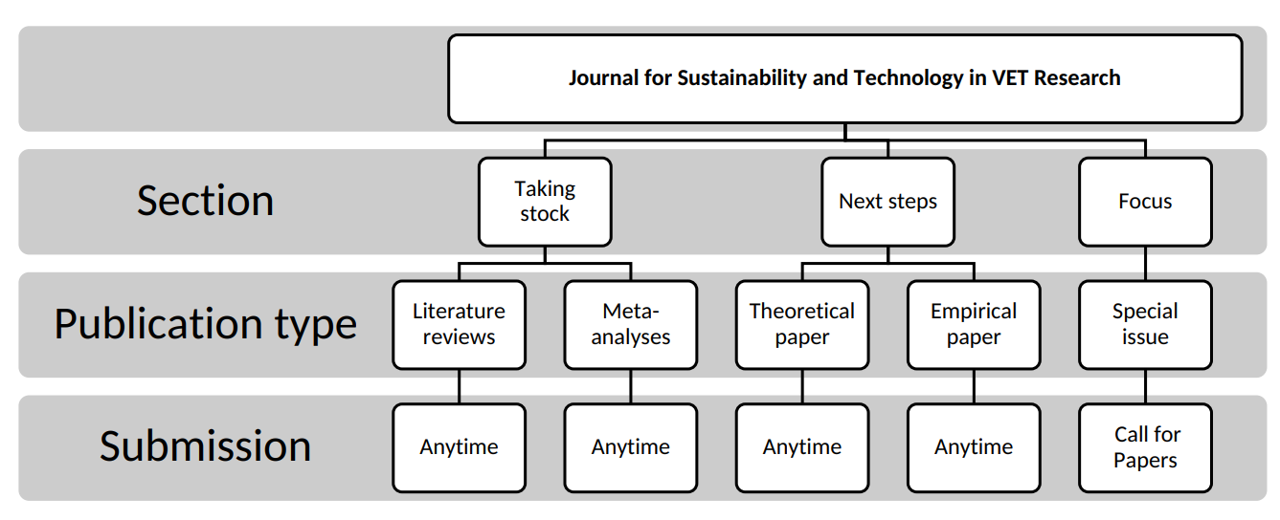
This journal regularly publishes special issues on specific topics. Calls for papers for these special issues are announced on the homepage and in the journal's announcements. Register with the journal to receive email notifications of futere special issues and other announcements.
Publication frequency
The journal publishes one issue per calendar year, which is filled successively throughout the year. Articles appear directly after successful completion of the review process and thus continuously and without fixed publication dates. Articles belonging to a special issue are published together with the respective special issue.
Editorial team
All editorial operations are entirely in the hands of the participating scholars (scholar-led publishing). The editorial team is free from any external influence. All members of the editorial team undertake to comply with the journal's ethical guidelines.
Double blind peer review
All articles undergo a double-blind peer review process with standardized criteria. The criteria vary depending on the category and can be accessed here.
Visibility
The articles are included in the following indices:
Archiving
All articles published by the journal are deposited on the archive server of the German National Library (DNB) and referenced in the DNB catalog. Hamburg University Press, the publishing house of the Hamburg State and University Library, holds all published volumes and articles in a sustainable manner.
Additionally, this journal participates in the PKP Preservation Network. This means that all content of the journal is archived within a private LOCKSS network. New content from the journal is automatically harvested. After a "trigger event" - either a clear message from the journal manager or the cessation of deliveries - the content is made available through the OJS instances of one or more LOCKSS partners.
INFO: LOCKSS is an acronym for "Lots of Copies Keep Stuff Save." The LOCKSS initiative is based on the premise that no single institution can provide long-term preservation. Therefore, this project consists of a cooperation of several libraries. The project was initiated and continued by the Stanford University Libraries. The LOCKSS software is open source.
Hamburg University Press
The journal is implemented as part of the publication services of Hamburg University Press and is hosted on the publisher's server.
Hamburg University Press is the open access publishing service of the Hamburg State and University Library (SUB). The publisher offers scholarly publication services. These include, in particular, the hosting of peer-reviewed open access journals along with consulting and support for their implementation, as well as the publication of books in both print and digital form (Diamond Open Access).